



Do I Need a Permit to Remodel My Bathroom in California?
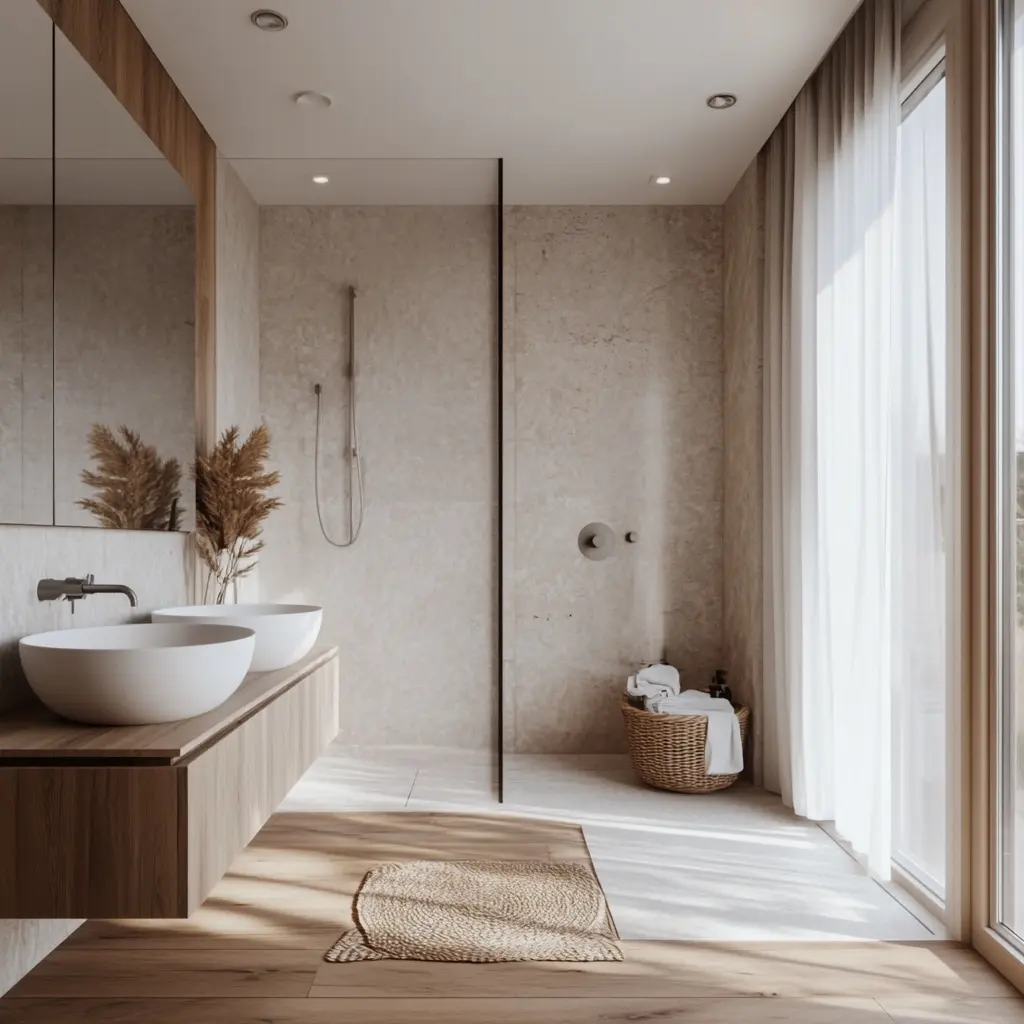
Yes, in most cases. In California you generally need a permit to remodel a bathroom when the project changes plumbing, electrical, walls, windows, or the layout, or when it adds a bathroom. Purely cosmetic work, such as painting, wallpapering, tiling, and installing cabinets or countertops, is exempt from permits under the state building code. Because each city applies the rules itself, the answer for your bathroom depends on the exact scope of work and on where you live.
At Jean-Prescott Studio, a Newport Beach architecture and design studio serving homeowners across California since 2014, we prepare plans and manage permit applications. We provide design and permitting only; we do not perform construction. This guide explains what needs a permit, what does not, what the process looks like in Los Angeles and Newport Beach, and what can go wrong if you skip it.
Key takeaways
- Permit usually required: moving or adding plumbing, new electrical circuits or wiring, removing or moving walls, changing windows, and adding a bathroom.
- Usually exempt under state code: painting, wallpapering, tiling, carpeting, cabinets, countertops, and similar finish work.
- Being exempt does not excuse code violations. The work still has to meet the building code.
- Cities differ. Some issue a quick over-the-counter permit even for like-for-like fixture replacement, so confirm with your building department before you start.
- Skipping a permit has consequences, especially when you sell: California sellers must disclose known unpermitted work, and that duty cannot be waived in an “as is” sale.
Do You Need a Permit to Remodel a Bathroom? The Short Answer
The California Residential Code requires an owner who intends to construct, enlarge, alter, repair, move, or demolish a structure to apply to the building official and obtain a permit first. That includes work on electrical, gas, mechanical, and plumbing systems. The same code lists a short set of exemptions, which is why the practical rule is simple:
Permit Required
If you are changing what is behind the walls or under the floor (pipes, wiring, framing), plan on a permit.
Generally Exempt
If you are only changing what you see on the surface (paint, tile, cabinets), you are generally exempt.
Most real bathroom remodels fall somewhere in between, which is why it pays to define the scope of work before you ask anyone for a quote.
Bathroom Remodels That Need a Permit in California
The table below summarizes the common triggers. It reflects the state code’s general approach; your city can be stricter.
| Type of work | Permit usually needed? | Why |
|---|---|---|
| Moving or adding a toilet, sink, shower, or tub | Yes (plumbing) | Rearranging fixtures or piping is not covered by the exemptions |
| Replacing drain, supply, or vent piping | Yes (plumbing) | Replacement of pipes is treated as new work |
| New circuits, new lighting circuits, or rewiring | Yes (electrical) | The exemptions cover only very minor electrical repair |
| Adding or relocating an exhaust fan with new ducting or wiring | Yes (mechanical or electrical) | New mechanical and electrical work |
| Removing or moving a wall, or enlarging an opening | Yes (building, with plans) | Structural changes need plan review |
| Changing a window, or its size | Yes (building) | Window work also triggers energy-code compliance |
| Adding a new bathroom | Yes (building, plumbing, electrical) | New space and new systems |
| Converting a tub to a shower | Usually (plumbing) | Typically involves drain and valve work |
Moving or adding plumbing
Under the state code, stopping leaks in pipes and clearing stoppages are exempt, but only if the repair does not require the replacement or rearrangement of valves, pipes, or fixtures. If a concealed pipe has to be replaced with new material, the code treats it as new work that needs a permit and an inspection. In practice, relocating a toilet, shower, or sink almost always requires a plumbing permit.
Electrical changes
The exemptions cover only very small tasks: reinstalling an attachment plug receptacle (but not the outlet itself), replacing a branch-circuit overcurrent device of the required capacity in the same location, and minor repair such as replacing lamps. Adding circuits, relocating outlets, or adding lighting circuits goes beyond that and needs an electrical permit.
Structural changes
Taking out a wall, enlarging an opening, or altering framing needs a building permit, and usually drawings. As one example from another California city, Rohnert Park requires a complete plan review when the structural system is modified and requires plans for a reconfigured layout, while in-kind fixture replacement does not need project plans.
Adding a new bathroom
A new bathroom adds space, plumbing, and electrical at once, so it needs permits for each. If the bathroom is part of an ADU, the ADU rules apply too; see our guide to ADU zoning and requirements in Los Angeles.
Bathroom Work That Usually Does Not Need a Permit
The California Residential Code lists “painting, papering, tiling, carpeting, cabinets, counter tops and similar finish work” among the work exempt from permits. In a bathroom, that typically covers:
Surface Finishes
- Painting and wallpapering
- Installing new floor tile or wall tile (as finish work, without changing the structure or plumbing)
Cabinetry & Minor Items
- Replacing cabinets and countertops
- Replacing lamps and similar minor electrical items
Two cautions apply. First, the code states that an exemption does not authorize work done in violation of the code or other local laws. Second, a cosmetic project can stop being cosmetic once it reveals a problem. Tile removal can expose damaged framing or old wiring, and fixing it may require a permit.
Fixture replacement is the gray area. The state exemption for plumbing covers leak repairs and clearing stoppages, but not replacing or rearranging fixtures. Many cities treat in-kind replacement of a toilet, sink, or faucet as a simple permit that can be handled over the counter, so ask before you assume it is exempt.
Permit Rules by City: Los Angeles, Newport Beach and Beyond
California sets the minimum, and each city and county administers it. That is why two neighbors in different cities can get different answers.
Los Angeles
The Los Angeles Department of Building and Safety (LADBS) handles permits for properties in the City of Los Angeles. Its homeowner process starts by confirming your property is inside the city using ZIMAS. LADBS issues three permit types, building, electrical, and mechanical (which includes plumbing and HVAC), and offers an Express Permit for simpler work and Plan Check for more complex projects. We did not find a bathroom-specific LADBS checklist, so confirm your scope with LADBS before you start. Properties outside the City of Los Angeles, in unincorporated areas or other cities, use a different office.
Newport Beach
Newport Beach’s Building Division publishes a residential minimum-requirements checklist citing the 2025 California codes and the city’s municipal code. It does not list when a permit is required, so contact the Building Division for your scope. Its checklist does show the standards a remodel has to meet: bathroom exhaust fans with humidity control and a minimum of 50 CFM, a dedicated 20-amp circuit, and GFCI protection, and it requires replacing non-compliant plumbing fixtures with water-conserving ones.
Other cities
Cities publish their own handouts. Rohnert Park’s bathroom checklist, for example, says that in-kind plumbing and electrical replacement can be handled over the counter without project plans, requires plans for layout changes, and sets ventilation, GFCI, and shower-wall requirements. Use it as an example of how detailed local rules can be, not as the rule for your city.
Which Permits Do You Need? Building, Plumbing, Electrical and Mechanical
A single bathroom remodel can involve more than one permit:
- Building permit: walls, framing, windows, and layout changes.
- Plumbing permit: moving or replacing fixtures and piping.
- Electrical permit: circuits, lighting, and outlets.
- Mechanical permit: exhaust fan ducting, and in some cases HVAC.
Whether you need one or several depends on your scope and on how your city issues them, which is why a clear scope of work comes first.
Who pulls the permit: contractor or homeowner?
Usually a licensed contractor pulls it. California’s owner-builder exemption allows property owners to do work themselves or hire licensed subcontractors in certain situations, subject to conditions, such as the work not being intended for sale. In Los Angeles, an owner who applies must complete an Owner-Builder Declaration. If you plan to act as your own contractor, check the current conditions with the Contractors State License Board (CSLB) before you apply.
How Much Does a Bathroom Remodel Permit Cost?
There is no single price. Permit fees depend on your city, the type of permit, and the valuation of the project, and cities publish their own fee schedules. In Los Angeles, LADBS offers a Permit Fee Calculator to estimate the cost for your project. Credit card payments there carry a 2.7% service fee, and some inspections outside regular hours are billed as off-hours.
Permit fees are usually a small part of a bathroom remodel compared with design, construction, and materials. For the larger picture, see our guide to the average cost to renovate a home. Remember that drawings and plan-check corrections are additional costs when your project needs them.
How to Get a Bathroom Remodel Permit, Step by Step
The exact steps vary by city. This is the Los Angeles process as LADBS describes it for homeowners:
- Confirm the jurisdiction. Check your property in ZIMAS to see whether it is in the City of Los Angeles.
- Gather your documents. Typically proof of ownership, a CSLB license check for your contractor, and, for building permits, a permitted waste hauler. Requirements vary by scope.
- Apply. Choose an Express Permit for simpler work or a Plan Check for more complex projects.
- Pay the fees. After plan approval, you receive payment instructions, and the permit issues after payment.
- Pass the inspections. Inspections happen in phases, and each is recorded on the Building Card (B-8). LADBS asks that you request regular inspections the day before, before 2 PM.
- Request the final inspection. Keep your records when the work is complete.
In Newport Beach, contact the Building Division at (949) 644-3200 to confirm requirements for your project.
For projects with layout or structural changes, the application usually includes drawings. Drafting and as-built plans of the existing bathroom make plan check faster, and if the city requests changes, we handle plan corrections.
What Happens If You Remodel Without a Permit?
Remodeling without a permit when one is required is not a risk-free shortcut. According to Bay Legal Aid’s guide to unpermitted work in California:
- Selling: A seller who knows about unpermitted work must disclose it. Under Civil Code section 1102, that disclosure may not be waived in an “as is” sale, and a late disclosure can let the buyer terminate.
- Enforcement: Local agencies can require abatement when work is substandard, and the owner chooses among repair, rehabilitation, vacating, or demolition.
- Legalizing it later: There is no state process to retroactively permit work. Approval runs through your local building department, and it can mean opening walls so the inspector can see what was done.
- Insurance and financing: Ask your insurer and lender in writing how unpermitted work would be treated.
This summary is general information, not legal advice. Talk to a California real estate attorney about your situation.
Special Situations: Older Homes, Accessibility and HOAs
- Homes built before 1978. Lead paint is a concern in any home built before 1978. Under the EPA’s Renovation, Repair and Painting Rule, contractors paid to disturb paint in pre-1978 homes must be certified and follow lead-safe practices. The EPA also notes that asbestos can appear in older floor tiles, adhesives, insulation, and textured finishes, and that exposure typically occurs when these materials are disturbed. Test suspect materials before demolition.
- Accessibility upgrades. Walk-in showers, wider doorways, and grab-bar blocking involve plumbing and framing, so they usually need permits.
- HOAs and condos. Your association may require approval in addition to the city permit, so check your rules.
How Jean-Prescott Studio Helps With Bathroom Permits
If your bathroom remodel changes the layout, moves plumbing, or touches structure, a permit-ready plan set saves time. Jean-Prescott Studio provides drafting and design, 3D renderings so you can review the layout before you build, plan permit processing, and plan corrections if the city requests changes. Our team includes a California-licensed architect and has completed more than 500 residential and commercial projects since 2014. After approval, you choose a contractor to build; we do not perform construction. See more on our home remodeling services.
Frequently Asked Questions
Do I need a permit to remodel my bathroom in California?
Usually yes, when the project changes plumbing, electrical, walls, windows, or the layout, or adds a bathroom. Cosmetic work such as painting, tiling, and installing cabinets or countertops is generally exempt under the state code. Cities apply the rules themselves, so confirm with your building department.
Can I remodel my bathroom without a permit?
Only if the work is exempt, such as cosmetic finish work. Skipping a required permit can create problems when you sell, because California sellers must disclose known unpermitted work and cannot waive that duty in an “as is” sale. It can also complicate insurance and require opening walls to legalize the work.
Do I need a permit to replace a toilet, vanity, or shower?
It depends on the city and the scope. The state exemption covers cabinets and countertops, but not rearranging or replacing plumbing fixtures. Many cities issue a simple over-the-counter permit for like-for-like replacement, and moving fixtures needs a plumbing permit. Ask your building department.
How much does a bathroom remodel permit cost?
There is no single price. Fees depend on your city, the permit type, and the value of the project. Los Angeles offers an online Permit Fee Calculator, and other cities publish fee schedules. Fees are usually a small share of the total remodel budget.
What happens if I remodel without a permit?
A seller who knows about unpermitted work must disclose it, and a late disclosure can let a buyer back out. The local agency can also require corrections, and legalizing the work later runs through your building department and may require opening walls for inspection. Confirm your situation with a real estate attorney.
Do I need a permit for a bathroom remodel in Los Angeles or Newport Beach?
In both cities, work that changes plumbing, electrical, or structure generally needs a permit. LADBS handles Los Angeles and offers Express Permits for simpler work, and Newport Beach’s Building Division can confirm the requirements for your scope at (949) 644-3200. Confirm before you start.
Start Your Ranch House Remodel With a Plan
A ranch house gives you a strong starting point: a simple footprint, a good lot, and a layout that welcomes change. Whether you want an open floor plan, a refreshed exterior, or an ADU in the backyard, Jean-Prescott Studio guides you from first sketch to approved plans.